

From Skin Bumps to Systemic Shock: Pet Allergy Responses Explained
When Your Pet’s Face Swells and It’s 11 PM: Knowing What to Do
Allergic reactions have a tendency to happen at the least convenient possible times. A bee sting during an evening walk, a new treat given as a reward on a Sunday, a vaccine reaction that takes three hours to show up after you have already left the clinic. And then you are standing in your kitchen at 11 p.m. watching your dog’s muzzle puff up, trying to decide whether this is the kind of thing that waits until morning or the kind of thing that cannot.
The answer depends on what you are looking at, and having that framework in your head before a reaction happens is one of the most genuinely useful things you can carry as a pet owner. The Veterinary Medical Center of Indian River County in Vero Beach provides 24/7/365 emergency care because situations like this are exactly why around-the-clock access matters. Allergic reactions do not follow a schedule, and our emergency services are staffed and ready every night, every weekend, and every holiday. If you see something and are not sure whether it warrants immediate care, call 772-217-4771 and someone will talk you through it. That call is always appropriate. Contact us any time.
What Causes Allergic Reactions in Dogs and Cats?
When the immune system encounters a substance it has decided to treat as a threat, it launches a defensive response. The mismatch between how serious the immune system thinks the threat is and how harmless the substance actually is determines how severe the resulting reaction becomes. Some triggers produce localized itching. Others trigger a cascade that affects the entire body within minutes.
- Environmental allergens are particularly significant in Vero Beach and the broader Indian River County area, where the subtropical climate means pets face allergen exposure that never fully stops. Oak, palm, and grass pollens cycle through different peaks across the year rather than being confined to spring and fall the way they are in northern states. Mold spores thrive in Florida’s humidity year-round, and sea oat and weed pollens add to the burden in coastal environments. Dogs with environmental allergies in this region often show symptoms across multiple seasons rather than in distinct windows, which can make the seasonal pattern less obvious than owners might expect.
- Insects are another major trigger category. Fire ant stings are a specific concern in this region and can provoke intense local and sometimes body-wide reactions in allergic dogs and cats who disturb a mound outdoors. Bee and wasp stings follow the same risk profile. Fleas, while not causing the possible severe anaphylactic reactions like fire ants, bees, and wasps, can cause severe itching and inflammation with just one bite.
- Food proteins such as chicken, beef, dairy, and eggs cause a significant proportion of year-round skin and GI reactions that do not follow seasonal patterns, which distinguishes them from environmental causes.
Our team works with owners to build an exposure history and identify patterns for their pet’s allergies, because knowing what a pet has been exposed to in the hours before a reaction dramatically shortens the investigation.
What About Reactions to Vaccines and Medications?
Vaccination reactions range from mild temporary responses, soreness at the injection site, brief fatigue, or a low-grade fever, to more significant reactions that typically develop within the first hour after administration. Some reactions appear up to 48 hours later, which is why monitoring in the days following any new vaccine or medication is important even when the pet seems fine immediately afterward.
For pets with a documented prior reaction, premedication with antihistamines before vaccination may be appropriate and is determined on a case-by-case basis. Our vaccination protocols are tailored to each patient’s history, which is why sharing complete medical and reaction records before appointments allows for the safest possible approach. Preventive care, including appropriate vaccination, remains important for every pet, and with advance planning the risk for sensitive patients is minimized without compromising their protection to potentially fatal diseases.
Hives, Respiratory Reactions, and Anaphylaxis: What Is the Difference?
Not every allergic reaction is an emergency, and knowing where on the spectrum a specific situation falls is what determines the right next step. The variable that matters most is how quickly signs develop and how many body systems are involved simultaneously.
Non-Emergency Allergic Reactions
Some reactions begin at the skin level without ever progressing further.
- Pets with contact hypersensitivity or chronic environmental allergies often show persistent itching of the paws, ears, and hindquarters, with repeated licking and scratching leading to hotspots and secondary skin infections if left unmanaged. This kind of reaction is not immediately dangerous but does warrant evaluation to prevent skin damage and identify the underlying cause.
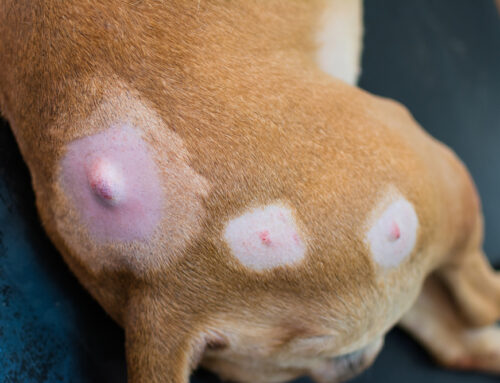
- Hives, called urticaria in medical terms, are raised, firm welts on the skin that develop as the immune system responds locally. They are commonly visible on the face, neck, and back in short-coated dogs, and are felt rather than seen in dogs with thicker fur. They are uncomfortable and worth veterinary attention to identify the trigger and prevent escalation, but they represent a contained skin-level response rather than a body-wide event.
Respiratory allergies that cause sneezing, coughing, or watery eyes tend to develop over longer timeframes and progress more slowly. These are uncomfortable but not typically cause for alarm.
Emergency Allergic Reactions in Pets
Anaphylactic allergic reactions are rare, but should be treated extremely seriously. The situation can progress from “that’s a weird behavior” to collapse and even death in a very short time frame- from minutes to hours.
- Anaphylaxis in dogs is the most severe end of the spectrum: a sudden, whole-body immune response that causes blood pressure to drop, airways to narrow, and organs to receive insufficient oxygen. It can progress from early signs to life-threatening collapse within minutes.
- Anaphylaxis in cats is equally serious but presents somewhat differently, often with intense respiratory distress and GI involvement, and because cats mask signs of distress very effectively, the visible symptoms may lag behind the physiological deterioration.
Any reaction involving skin, GI, and respiratory signs simultaneously should be treated as urgent. Our 24/7 emergency capability exists precisely for these scenarios. Our team is equipped to triage, stabilize, and treat anaphylaxis and acute allergic reactions at any hour, and our diagnostic imaging and in-house lab capabilities support rapid assessment.
What Signs Tell You It’s an Emergency?
A Practical Guide to Monitoring vs. Moving Right Now
The most useful thing this section can do is help you make a faster decision when time is the variable that matters.
Signs that warrant prompt a call to your veterinarian and likely same-day evaluation:
- Facial swelling around the muzzle, eyes, or ears that is present but not visibly spreading
- Sudden intense itching, pawing at the face, or widespread licking
- Raised, firm welts appearing on the skin
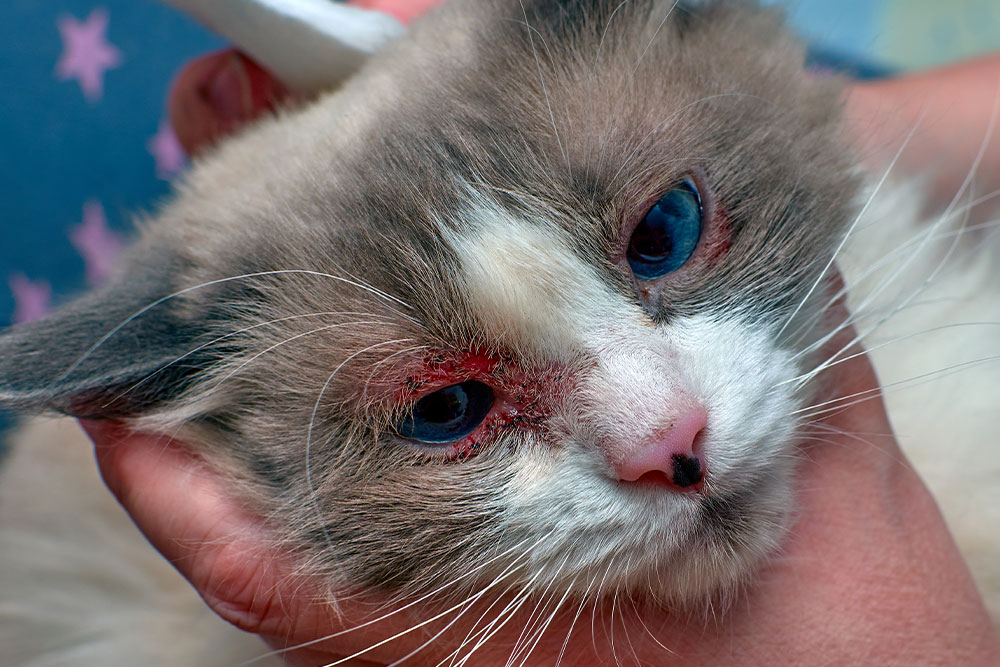
- Red, watery, or squinting eyes
- Single episode of vomiting or diarrhea in the hours after a new food or exposure
- Behavioral restlessness without another obvious explanation
These allergy symptoms are worth monitoring closely and reporting. They do not always represent a crisis in the first moments, but they should not be left to resolve on their own without guidance.
Signs that require immediate care, no waiting:
- Labored, rapid, or audible breathing, or gasping
- Open-mouth breathing in cats, which is always abnormal and signals respiratory compromise
- Collapse or sudden inability to support their own weight
- Pale, white, or bluish gums
- Visible swelling progressing toward the throat or neck
- Vomiting or diarrhea continuing for more than an hour without improvement
- Weak, racing, or irregular pulse
Checking gum color takes seconds. Lift the lip and look. Pink and moist is normal. Anything pale, white, or blue indicates inadequate circulation and requires immediate veterinary care. If any of the emergency signs above are present, call 772-217-4771 right now rather than waiting to observe further. Our team answers at any hour and will guide your next steps.
What Should You Do at Home While Getting Your Pet to Care?
Taking calm, purposeful action in the first few minutes of a reaction limits progression while you arrange care. Here is a practical sequence:
- Identify and remove the trigger if possible. If skin contact with a substance caused the reaction, rinse the area with cool water. Avoid applying soaps, lotions, or other products unless our team directs you to.
- Keep your pet still and as calm as possible. Physical exertion increases circulation, which moves allergens through the body more quickly. Carry small pets to the car rather than walking them.
- Prevent self-injury during transport. If scratching is intense, a cone or e-collar and booties on the feet reduce skin trauma.
- Document what you can. Note the time symptoms appeared, any new foods, products, or exposures in the preceding hours, and photograph visible swelling or skin changes. This information is immediately useful when our team begins their assessment.
- Do not give human medications without guidance. Some antihistamines are safe for pets at specific doses, but many formulations contain decongestants or xylitol that are toxic to dogs and cats. Call us before giving anything.
If you have a pet with a documented reaction history, we can discuss during a wellness exam whether keeping a specific antihistamine on hand is appropriate, so you are never improvising in a stressful moment.
How Are Emergency Allergic Reactions Treated?
Emergency treatment for anaphylaxis requires epinephrine to interrupt the immune cascade, intravenous fluids to stabilize blood pressure, anti-inflammatory medications, and oxygen support for respiratory compromise. Pets with severe reactions should be monitored closely in hospital, even after the initial reaction has passed. In some cases, the anaphylactic reaction can return up to 72 hours later. This is called a “biphasic” reaction, and can be even more severe than the first reaction.
Our team is equipped to monitor and manage acute allergic reactions with state-of-the-art equipment and around-the-clock staffing, and our emergency services support the full range of interventions these cases may require. Most mild reactions resolve well with timely treatment. Severe cases require close monitoring over several hours, and some require overnight hospitalization, which our 24/7 model supports directly.
How Can You Reduce the Risk of Future Reactions?
Prevention works best when it is consistent and tailored to the specific triggers driving a pet’s reactions.
Grooming and Skin Care
Regular grooming lowers the environmental allergen load a pet carries on their coat. In Florida’s climate, where allergen exposure is essentially continuous, this matters more than in regions with distinct dormant seasons. Rinsing after outdoor time removes pollen and mold spores before they are absorbed or ingested during self-grooming. Professional grooming and medicated baths are available at VMC for pets whose allergy management benefits from regular professional care.
Topical therapies for allergic skin used consistently between veterinary visits support the skin barrier and reduce flare severity over time. For pets with reactive or sensitive skin, we love using DOUXO S3 CALM Shampoo and DOUXO S3 CALM Mousse to calm skin reactivity, Aloe and Oatmeal Shampoo and Aloe and Oatmeal Conditioner for regular gentle bathing, and Relief Shampoo and Relief Spray for targeted itch relief between baths.
Parasite Control
Flea allergy dermatitis is driven by flea saliva, not flea numbers, meaning a single bite is enough to trigger intense, widespread inflammation in a sensitized pet. In Vero Beach’s climate, fleas are active year-round without exception. Year-round parasite prevention is non-negotiable for flea-allergic pets, and our pharmacy carries dog flea and tick prevention and cat flea and tick prevention to keep protection continuous.
Medications For Flare-Ups
For pets with documented severe reactions to stings or other acute triggers, keeping epinephrine at home is worth discussing with us. Not every patient needs this, but for those with a prior anaphylactic history, having it available can be the difference between a manageable outcome and a catastrophic one.
Antihistamines like Benadryl or Zyrtec can also be beneficial when your pet’s allergies flare up or for daily maintenance, but it must be the right dose and formulation. Ask us, and we’ll help make sure you have the right dose and product.
Medications for Long-Term Maintenance
Long-term management for environmental allergies often includes immunotherapy, which gradually desensitizes the immune system through repeated controlled exposure to specific allergens. It is the most effective option for reducing reaction frequency and severity over time. For managing active symptoms, Apoquel and Cytopoint are both proven, well-tolerated options for itch and inflammation control. We evaluate each patient individually to determine which combination fits their history and needs.
How Do Food and Environmental Changes at Home Help?
For suspected food allergies, elimination diet trials are the only reliable way to confirm or rule out dietary sensitivity. A single novel or hydrolyzed protein diet is fed exclusively for eight to twelve weeks, with zero exceptions including treats, table scraps, flavored medications, and supplements. If symptoms improve during the trial and return when the original diet is reintroduced, food allergy is confirmed and ongoing management centers on diet selection. Our team provides nutritional guidance to identify the right trial diet for each patient’s history.
Florida’s high indoor humidity creates favorable conditions for both mold and dust mite populations, so environmental management includes dehumidification, HEPA vacuuming, and weekly hot-water laundering of pet bedding to lower the ambient allergen burden.
Frequently Asked Questions About Allergic Reactions in Pets
Is it ever safe to wait and see if an allergic reaction resolves on its own?
For mild hives without other signs, monitoring closely while contacting us is reasonable. For any breathing difficulty, pale gums, collapse, spreading facial swelling, or persistent vomiting, waiting is not safe. Our team is always available to help you make that call. Contact us or call 772-217-4771 any time you are uncertain.
Can I give my pet a human antihistamine at home during a reaction?
Not without checking with us first. Some antihistamines are safe for dogs and cats at specific doses, but many over-the-counter formulations contain decongestants or xylitol that are toxic to pets.
How do I prevent flea-related allergic reactions?
The most reliable approach is consistent year-round flea prevention, since flea allergy dermatitis can be triggered by a single bite in a sensitized pet. In Vero Beach’s climate, there is no off-season for fleas, so continuous protection is essential rather than optional.
Could my pet have a food allergy?
Possibly. Food allergies tend to cause year-round skin and GI symptoms that do not follow seasonal patterns, which helps distinguish them from environmental causes.
Prepared Care for Every Moment
Allergic reactions range from mildly annoying to life-threatening, sometimes within minutes of each other on the same severity scale. The warning signs that most urgently require action are spreading facial swelling, worsening breathing, pale or blue gums, and collapse. If any of those are present, move immediately.
For ongoing allergy management, we build individualized plans that match each pet’s specific triggers, history, and lifestyle in Vero Beach’s subtropical environment. From parasite prevention and skin care to immunotherapy and dietary management, the goal is always the same: fewer reactions, better quality of life, and the confidence that comes from knowing your team is available any time something changes.
Request an appointment to get started on a proactive allergy management plan, or contact us if you’re worried– any time, day or night, when you need guidance. We are here 24/7/365, because protecting the bond between you and your pet is exactly what we built this practice to do.



Leave A Comment